The NRC Atomic Safety & Licensing Board has dealt a major blow to efforts to restart the crippled San Onofre reactor. The Board has ruled that the restart is a de facto license amendment proceeding which requires an adjudicatory hearing to determine if the reactor s safe. A recent CBG study on San Onofre was cited by the judges in support of their decision.
Rather than the nuclear revival hoped for by the industry, the gearshift has been thrown hard in reverse. Instead of a proliferation of new plants, existing reactors are getting shut down long before their licenses expire. And this is due largely to short-sighted safety shortcuts by the industry and its compliant regulators. They have been their own worst enemies.
The poster child for this revival-in-reverse is San Onofre, located between Los Angeles and San Diego, with 8.5 million people living within 50 miles. Last week, Southern California Edison announced it could permanently close both units if the NRC didn’t soon grant its request to allow restart of the crippled Unit 2 without a prior hearing to determine if it is would be safe to do so. Ironically, it was precisely the same effort to bypass full safety review that led to the failure of the steam generators in the first place.
San Onofre’s original steam generators were supposed to last 40 years, but failed in about 25. Edison decided to replace them with a substantially different design, but, in order to avoid triggering NRC safety review and the prospect of an adjudicatory hearing, it told NRC that they were a “like for like” replacement and should be permitted to bypass that review. NRC, as usual, acquiesced.
In less than a year, the steam generators in Unit 3 failed, with a tube bursting, releasing radioactivity and triggering a shutdown. It was then discovered that hundreds of tubes in both Unit 2 and 3 had become damaged. Although Edison has claimed that Unit 2 is less bad off than Unit 3 our research has shown that the damage is pretty comparable—1600 damaged tubes in Unit 2 and 1800 in Unit 3. That is 400 times the norm for new steam generators nationally. More tubes have had to be plugged at San Onofre than in all new steam generators in the country combined.
Edison recognizes that the steam generators need to be repaired or replaced, but that would be very expensive and take many years. So it has proposed restarting Unit 2 at 70% power for 5 months – and hope for the best. Its own analyses show that even at 70% power the reactor can’t run for more than 16 months without an unacceptable risk of tube burst. But it wants to start up anyway, and limp along.
To do that, it must repeat the mistake that caused the problem in the first place – avoid a full hearing as to whether what it proposes is safe. So it has asked the NRC to give it a license amendment now, and hold any safety hearing after the fact. That is like the Old West judge saying, “Hang ‘em now; we’ll give ‘em a fair trial later.” It is clear that Edison is not confident that its restart proposal can withstand scrutiny. Rather than come up with a safe plan forward, it is trying to bypass that needed hearing.
Edison seems incapable of learning from experience. The effort to bypass a safety hearing is what led to the billion dollar failure of the new steam generators in the first place. NRC says it believes the problem would have been caught in the design stage if Edison hadn’t bypassed a full license amendment process then. But Edison is desperately hoping to avoid a safety hearing again, this time for the far more consequential proposal of running a damaged reactor with a 1000 times the long-lived radioactivity of the Hiroshima bomb without repairing it.
Edison now says it will close both units if the NRC doesn’t quickly acquiesce to this repeat bypass of safety review and allow Unit 2 to start up at 70% power for 5 months. There are many obstacles to this occurring. But even if Edison were to get its way, which is by no means clear, the steam generator tubes may not cooperate. Edison’s own analysis says Unit 2 can’t operate for much more than a year even at 70% before getting into the danger zone. And even could it operate longer, at best they would have a 2 unit plant running at 35% of its overall power, with costs close to that of running both units at full power. San Onofre is not long for this world. And that is a significant signal for the nuclear industry as a whole.
EPA has just issued (April 15, 2013) new Protective Action Guides (PAGs) for dealing with radioactive releases. The new PAGs are in many ways worse than the extremely weak PAGs Bush tried to push out in the last days of that Administration that Obama pulled back. The PAGs eliminate requirements to evacuate people when thyroid or skin radiation doses exceed certain levels, lift a lifetime limit on radiation from such an event that would have triggered relocation, recommend dumping radioactive waste in municipal garbage dumps not designed for such waste, and propose five options for drinking water, all of which would dramatically increase the permitted concentrations of radioactivity in drinking water, by as much as 27,000 times.
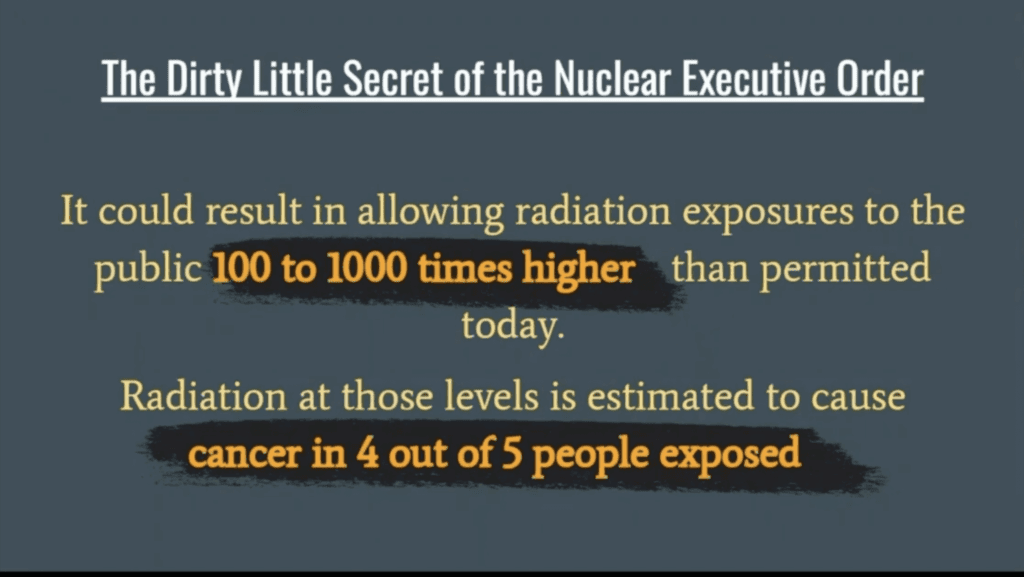
Additionally, the National Council on Radiation Protection and Measurements (NCRP) has published draft guidance for implementing the long-term cleanup portions of the PAGS. The NCRP guidance would allow the public to be exposed to extraordinarily higher levels of radiation than previously permitted, sufficient to cause a cancer in every sixth person exposed. Although public comments are supposedly being solicited, EPA has made the PAGs immediately effective, making the comment opportunity pretty meaningless.
EPA PAGs suggest permitting radioactive concentrations in drinking water orders of magnitude higher than EPA has long deemed acceptable pursuant to the Safe Drinking Water Act. Below you will find two charts which detail the suggested concentrations. You may view them in detail by clicking on them below:
Click the image to view the chart in detail
Click the chart to view the data in detail
CBG Powerpoint Presentation to Gina McCarthy (current EPA Administrator nominee) and other senior EPA officials opposing weakening of protections.
Below you will find two charts which demonstrate the dramatic increase in permissible radioactive contamination, click on the images below to view the data in detail:
The San Francisco Chronicle reports that the repair costs for San Onofre are exploding. Meantime, after years of employee complaints, KPBS reports that federal regulators are now looking into claims that San Onofre’s cyber-security training is outdated, at best. The San Diego Union Tribune also reports that 70% power at San Onofre seems to be the “new norm.”
In a letter to Secretary of Energy Steven Chu, CBG’s Dan Hirsch notes that the proposed policy change would “allow members of the public to be exposed to the equivalent of dozens of chest X-rays over their lifetimes from exposure to DOE nuclear waste, with no medical benefit and no informed consent.” As the National Academy of Sciences (NAS) has repeatedly determined, all doses of radiation increase the risk of inducing cancer and leukemia. Hirsch goes on to conclude that the “American public should not be made into a kind of cheap disposal receptacle for DOE’s radioactive waste.”
The current policy banning the use of radioactive scrap metal in consumer products was put in place by former DOE secretary Bill Richardson after the public learned that the DOE had been shipping radioactive scrap metal from a partial nuclear meltdown site to metal recycling companies, and was planning to sell contaminated metals from the Oak Ridge nuclear facility to scrap yards for consumer use as well. These and other actions produced an outcry which led Secretary Richardson to suspend the practice, and then issue an order requiring new rules be established barring release of metals with detectible contamination above background.
Secretary Richardson also ordered an end to the practice until the results of an NAS study were released and required that a Programmatic Environmental Impact Statement (PEIS) be completed by DOE before it would even contemplate returning to radioactive scrap metal recycling.
Now, Secretary Chu is considering issuing an order to reverse DOE policy and allow radioactive scrap metal recycling even though a PEIS was never completed and the NAS study concluded that there was such public concern about such a practice that it should not be approved unless there were significant public processes initiated to create a consensus on its acceptability.
Read CBG’s letter to the Department of Energy here.
Below you will find a link to CBG’s 2012 annual report as well as a link to our annual report archive. The annual report discusses CBG’s work for the year.
You may download a PDF of CBG’s 2012 annual report by clicking here
After a three-year study, the Environmental Protection Agency confirmed that the SSFL site suffers from excessive levels of radioactive contamination.
CBG’s Dan Hirsch is quoted by the Ventura County Star regarding the news:
“We get bulldozed over constantly,” Dan Hirsch, of the watchdog nuclear group Committee to Bridge the Gap said before the meeting. “Three years, stimulus funds — you’re not supposed to mess around with stimulus funds. … The good news is they have done the study and they found all the contamination. The bad news is that people within DTSC and apparently EPA are trying to upend the very commitments they were supposed to carry out.”