
Updates
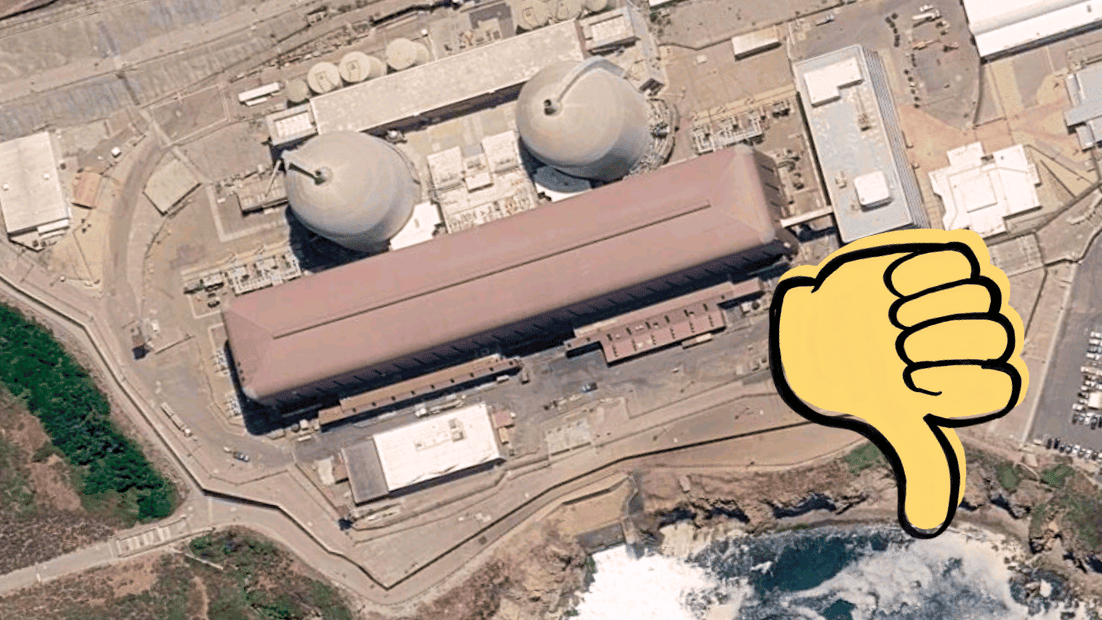
Environmental Orgs Sound Alarm on Extending Diablo Canyon’s Operations into 2045

Action needed to address Diablo Canyon safety risks
When you combine AI and nuclear power, the results can be catastrophic (The Hill)
California’s last nuclear plant is a risky, costly business (Los Angeles Times)
Earthquake risks and rising costs: The price of operating California’s last nuclear plant (Los Angeles Times)
What comes next for Diablo Canyon after a budget debacle and over $1B loaned to PG&E? (Sacramento Bee)
Diablo Canyon Nuclear Power Plant
THE ENVIRONMENTAL leader David Brower once defined a nuclear power plant as a complex technological device for locating earthquake faults in California. Wherever the industry decided to site a nuclear reactor, earthquake faults were soon discovered.
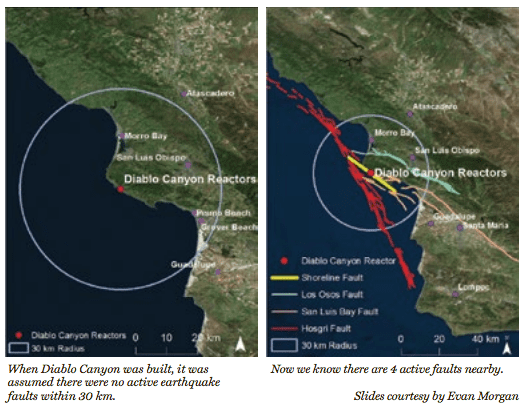
When Pacific Gas & Electric (PG&E) proposed a nuclear plant at Diablo Canyon, near San Luis Obispo, it claimed there were no active faults within 30 kilometers. It therefore designed the plant to withstand only a modest quake. During the construction permit hearings before the Atomic Energy Commission licensing board, a local intervenor group asked to be able to put on an afternoon of testimony by a local geologist about the prospect of a nearby fault. PG&E in its wisdom, objected, and the AEC board refused to hear the evidence. Tom Pigford notably dissented, saying shouldn’t we find out before they pour concrete whether there is a fault nearby? The AEC granted the permit nonetheless.
CBG’s Dan Hirsch testifies before Congress regarding nuclear negligence at the Diablo Canyon Nuclear Power Plant
A few years later, and when the plant was already 80% built, two oil industry geologists discovered the Hosgri Fault, coming within 4 kilometers of the plant, and capable of causing ground motion far in excess of what the plant was designed to withstand. The NRC allowed the plant to go forward, nonetheless, with some minor upgrades that PG&E also failed to properly manage. Because the reactors were built to mirror image blueprints of each other, PG&E put the pipe supports and whip restraints in all the wrong places, because they used the wrong set of blueprints.
Subsequently the San Luis Bay Fault was discovered near the plant; then the Los Osos Fault; and then finally, the Shoreline Fault, coming within 600 meters of the plant. And they were found to be interconnected. Working with geologists Dr. Jerry Weber (who years earlier had discovered part of the fault system) and Dr. Sam Blakeslee (who had been a State Senator representing the Diablo area), CBG demonstrated that the new seismic information resulted in potential ground motion at the plant in excess of what the plant was designed or licensed for. A massive nuclear accident was thus possible. Blakeslee and CBG’s Dan Hirsch testified before the U.S. Senate Environment Committee.
CBG played a role with the State Water Board to assure Diablo continued to be required to install cooling towers to stop the killing of massive numbers of fish by its current intake of ocean water for cooling and discharge of heated water. CBG uncovered the fact that the leases from the state for use of the submerged lands off Diablo for outfalls and inlets was expiring, giving the State Lands Commission power to close the plant by simply not approving extensions of the leases.
The seismic revelations, the cooling tower requirements, and the expiring leases, as well as economic factors resulting from increased reliance on cheap renewables, led PG&E to agree to phase-out the reactors by 2024 and 2025.
In 2022, Governor Newsom reversed the phase out agreement by pushing a last minute bill through the California Legislature. With the extension, the future of Diablo Canyon is unclear.
Public Comments
Presentations
June 28, 2024 - "Nuclear Power and California’s Diablo Canyon," presented by Daniel Hirsch
June 10, 2020 - "Accepting Nuclear “Attributes” from Diablo Canyon Would Violate MBCP’s Central Mission: Clean Power, Community Choice," presentation to the Policy Board of Monterey Bay Community Power by Daniel Hirsch